Torch-on, self-adhered and cold-applied
Modified bitumen roofing
Modified bitumen is the asphalt-based roll roofing you will see on many Toronto-area houses and townhouses. It comes in layers, it flashes tight corners well, and it can be installed with or without a torch.
- Two-ply system
- Good for tight details
- Torch-free options
What modified bitumen is
Modified bitumen ("mod bit") is asphalt blended with a polymer, usually SBS rubber, and reinforced with a polyester or fibreglass mat. The rolls are about a metre wide and a few millimetres thick. A typical system has a base sheet and a cap sheet, so there are two layers of waterproofing, and the cap often has a mineral granule surface that shields it from the sun.
A mod bit roof commonly lasts 15 to 25 years. Replacement is priced from $8 per sq ft.
Three ways to install it
Torch-on
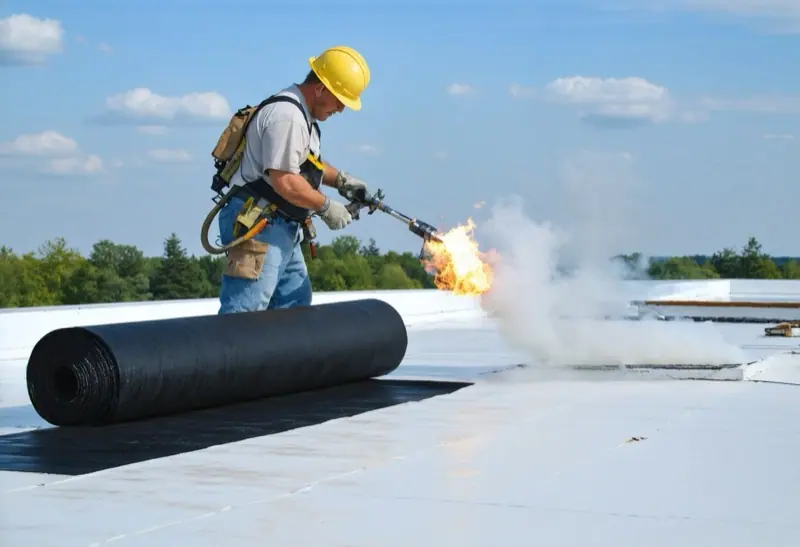
A propane torch heats the underside of each roll so the asphalt melts into the layer below. Strong, well-proven laps. Open flame is the risk, so it needs trained installers, fire watch and careful work near combustible parts of a building.
Self-adhered
Rolls have a peel-and-stick back. No flame, less odour and good for wood-frame buildings, though cold weather can slow adhesion and it needs a primed, clean surface.
Cold-applied adhesive
Rolls are bonded with a liquid asphalt adhesive. No flame, and a sound option for roofs where a torch is unsafe. Many contractors use cold-applied or self-adhered systems where a torch is unsafe.
Why it is common on Ontario houses
Older houses in Toronto, Hamilton and Ottawa often have a flat rear roof over a kitchen or addition, with a brick wall on one side and an awkward chimney or vent stack. Rolls that can be cut and heated, or self-adhered, shape well around those corners. The cap sheet takes sunlight and foot traffic better than a thin single-ply and many owners like the thickness.
The deck underneath matters. Mod bit is installed over a wood or concrete deck with insulation and a cover board, and there should be a proper ventilation or vapour plan so moisture does not collect in the layers. If you are unsure, see the flat roof replacement page for what a tear-off involves.
Pros and cons
Two layers of protection
A scratch in the cap does not always mean a leak, because the base sheet is still there.
Tight details
Flashings can be built up in the field around odd shapes, curbs and drains.
Easy to patch
A cut-out and a new piece of cap sheet fix most punctures and splits.
Open flame risk
Torch-applied work needs strict safety practice. We recommend a flame-free option where there is any doubt.
Seams can open with age
Laps can lift where the roof has moved or where heat from sun and cold from winter have worked on them repeatedly.
Dark and heavier
The surface gets hot in summer, and the roll system is heavier than a thin single-ply.
How a mod bit repair goes
Find splits and open laps
We look at lap lines, flashing terminations and blistered areas first, since that is where mod bit usually gives up.
Cut out damaged cap
Wet or blistered material is cut away. If the base sheet or insulation is wet, it is replaced rather than covered.
Patch with a matching sheet
A new piece of the same type is bonded with cold adhesive, self-adhesive or heat, and edges are sealed.
Re-flash weak terminations
The top of a wall flashing is reset and counter-flashed so water cannot get behind it.
Modified bitumen pricing
| Item | Starting price |
|---|---|
| Modified bitumen (torch-on or SBS) replacement | from $8 per sq ft |
| Small flat roof replacement (garage, porch or addition) | from $4,000 per roof |
| Small leak repair (patch, seam or puncture) | from $350 per repair |
Starting prices in CAD before 13% HST, based on typical Ontario contractor rates (mostly Toronto and the GTA). The final price depends on roof size, access, the layers to remove, the membrane, drains and flashings, and is confirmed in your written quote.
Modified bitumen questions
Is torch-on roofing safe?
It can be, in the hands of trained installers who follow fire-watch practice. Where the building is wood-frame or has combustible material close to the roof edge, a self-adhered or cold-applied system removes that risk.
What are the blisters on my mod bit roof?
Pockets of trapped moisture or air between layers. Small ones can be left under watch, but cracked blisters let water in. See blisters.
How is mod bit different from tar and gravel?
Tar and gravel is built on site with several plies of felt and hot or cold bitumen. Mod bit uses factory-made rolls with a polymer added, so it is more flexible and faster to lay. See built-up roofing.
Leak, damage or an old flat roof?
Send a few details and photos. We reply by email with next steps and a written quote.