The usual suspect
Flashing leaks
Flashing is the waterproofing that turns the roof up a wall or around a pipe. It is complex, it moves, and it is where most flat roof leaks begin.
- Most common leak source
- Walls, chimneys, vents, curbs
- Often a small repair
Where flashings are
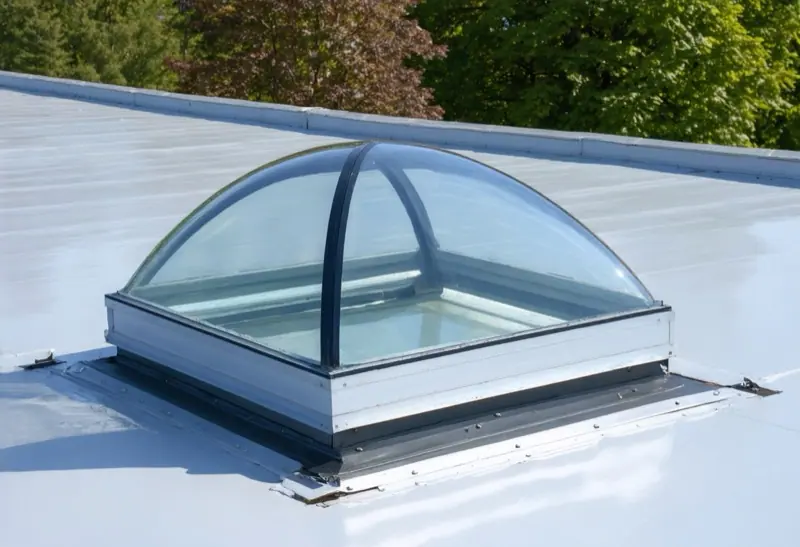
Every place the flat part of the roof meets something vertical has a flashing: the base of a brick wall, a parapet, a chimney, a plumbing vent, a skylight curb, the edge of a roof hatch, a rooftop unit. A typical Toronto house with a flat rear roof has a long wall flashing where the roof meets the main house. That single line often causes most of the trouble.
Flashing includes the membrane turned up the wall, any metal on top of it (counterflashing or a termination bar), and the sealant that joins them. The weak link is often the top edge, where water runs behind it.
Why flashings fail
Sealant dries out
Caulk was never meant to be the primary waterproofing. It shrinks and cracks, and then the flashing relies on a gap.
Membrane pulls away
Shrinkage and movement drag the flashing down the wall. A gap opens at the top edge.
Brick and mortar issues
Water gets behind a termination through failing mortar or a cracked parapet cap.
Cold-weather movement
The roof and the wall move at different rates. Flashings that cannot flex tear at corners.
Pipe boots wear out
Rubber collars around plumbing vents crack from sun exposure and let water down the pipe.
Cheap patching
Layers of roof cement over old flashing hide the real condition and eventually peel away.
How to tell a flashing leak
The stain tends to sit near a wall or a penetration, and it appears when rain is driven against the wall, or when snow melts against it. Leaks that only happen in wind-driven rain are classic flashing or parapet symptoms. A leak in the middle of the roof away from any detail is more likely a membrane puncture or seam.
If the stain is on an interior wall below the roof edge rather than the ceiling, water may be running down inside the wall cavity. That is a reason to get it looked at quickly.
What you can safely do yourself
Check from inside
Look at the upper corner of a wall below the roof edge and around vent pipes in the attic or ceiling for stains or damp insulation.
Check from the ground
Binoculars show loose metal caps, missing sealant and membrane hanging off a wall.
Do not bury it in sealant
A thick bead of caulk may stop a drip for a week but leaves a harder repair afterwards.
How flashings are rebuilt
Strip the failed section
Old caulk, loose membrane and corroded metal are removed back to a solid substrate.
Rebuild the flashing
New flashing membrane is bonded up the wall at a suitable height and corners are formed properly, not folded and sealed.
Fix the termination
A new termination bar or counterflashing is fastened and sealed so water cannot run behind the top edge.
Check mortar and caps
If masonry is part of the problem, we say so. It sits outside our work but needs fixing for the repair to last.
Typical costs
| Item | Starting price |
|---|---|
| Flashing repair or replacement | from $500 per repair |
| Skylight, curb or vent reflashing | from $350 per opening |
| Small leak repair (patch, seam or puncture) | from $350 per repair |
Starting prices in CAD before 13% HST, based on typical Ontario contractor rates (mostly Toronto and the GTA). The final price depends on roof size, access, the layers to remove, the membrane, drains and flashings, and is confirmed in your written quote.
Flashing questions
Does a flashing leak mean I need a new roof?
Not usually. If the main membrane is in good shape, reflashing a wall or curb solves it. See repair or replace.
Why does my roof only leak in wind-driven rain?
Water is being pushed sideways into a gap at a wall, parapet or vent. Rain that falls straight down does not reach it.
How long should a flashing repair last?
A properly rebuilt flashing outlasts a sealant fix by a wide margin. Get the method, not just the price, in the quote.
Leak, damage or an old flat roof?
Send a few details and photos. We reply by email with next steps and a written quote.