The cheapest problem to prevent
Clogged drains and scuppers
A flat roof depends on its drains. When they clog, water has nowhere to go, and the roof becomes a shallow pond.
- Easy to prevent
- Check twice a year
- Link to ponding and leaks
How roofs drain
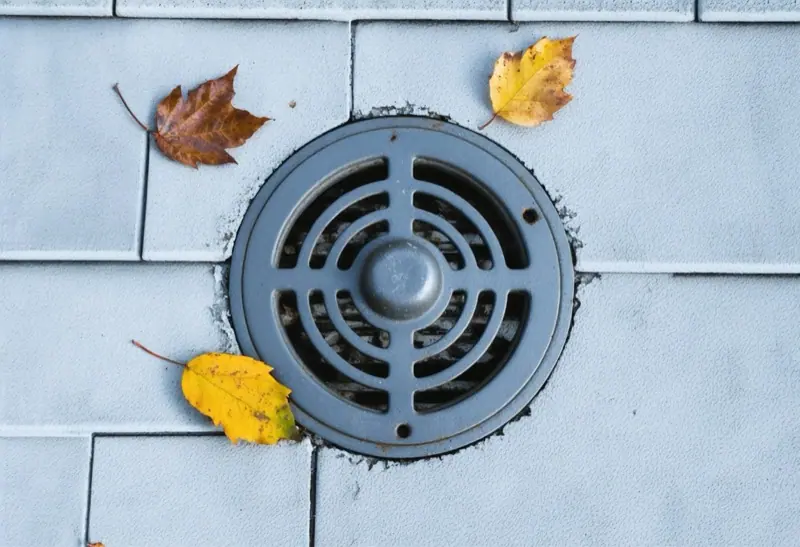
Flat roofs shed water in three common ways. Interior drains sit in the field of the roof with a pipe running down through the building. Scuppers are openings through a parapet wall that let water pour out the side, often into a downspout box. Some small roofs drain to an edge with an eavestrough. Any one of these can clog.
Interior drains are the easiest to forget about, because you cannot see the pipe. A drain can be blocked a metre below the roof and still look open on top.
What blocks them
Leaves and seeds
Maple keys in spring and leaves in fall collect at the strainer.
Roof grit
Gravel, granules and silt wash into a drain and settle in the pipe.
Debris from nearby work
Construction dust, paint chips and trades leaving materials on a roof end up in the drain.
Ice
A drain that freezes will not carry meltwater. Water refreezes on the roof and grows.
Damaged or cracked pipe
A crushed or separated drain pipe slows water or leaks into the ceiling below.
Missing strainers
Without a dome strainer, larger debris goes straight into the pipe.
Why it matters in Ontario
Spring melt can dump a winter of snow in a few days. If the drain is half blocked, the roof fills quickly. Standing water seeps through any small defect. Then comes the overnight freeze, and the pond turns to ice on top of a clogged drain. See ice and snow damage for what follows.
Heavy summer storms are the other test. A drain that copes with an hour of light rain may overflow in a thunderstorm. Roofs with scuppers and no overflow openings are especially vulnerable.
What you can safely do yourself
Check after rain from a window or the ground
Is water still ponding near the drain a day later? Is the downspout dry during rain when it should be running?
Clear a low, dry roof in summer
If you have an easy and safe access to the roof, remove leaves and debris by hand. Do not use sharp tools that can cut the membrane.
Never go on in winter
Do not chip at ice on a drain. You can puncture the membrane or fall.
Look at the downspout outlet
A dry downspout in a downpour means a blockage upstream.
How a roofer handles it
Clear the strainer and basin
Debris is removed by hand and the drain bowl is cleaned.
Flush the line
Water or a drain snake tests the pipe. If it backs up, the blockage is below the roof and a plumber may be needed.
Repair the drain flange
Cracked flanges, loose clamping rings and worn drain boots leak at the connection to the membrane. These are resealed or replaced.
Improve drainage
Where one drain cannot handle the roof, an overflow scupper or extra drain is worth discussing.
Typical costs
| Item | Starting price |
|---|---|
| Roof drain or scupper repair | from $800 per drain |
| Maintenance visit (drains, seams, flashings, photos) | from $295 per visit |
Starting prices in CAD before 13% HST, based on typical Ontario contractor rates (mostly Toronto and the GTA). The final price depends on roof size, access, the layers to remove, the membrane, drains and flashings, and is confirmed in your written quote.
A maintenance visit twice a year, spring and fall, is the simplest way to keep drains clear.
Drain questions
How often should drains be checked?
At least in spring and fall, and after big storms if trees overhang the roof. See the maintenance checklist.
Is a blocked drain covered by a roof repair?
Clearing a drain is a maintenance job. Repairing a damaged drain flange or boot is a repair. Both can be on the same visit.
Does a clogged drain always cause leaks?
No, but it makes any weak spot much more likely to leak. Standing water finds every pinhole and seam.
Leak, damage or an old flat roof?
Send a few details and photos. We reply by email with next steps and a written quote.